
Another week of Women in Translation Month gone and more great books read! My TBR doesn’t seem to be shrinking any though, despite my best efforts, ha! Last week a few people told me they enjoyed seeing my diary-esque weekly reading wrap up, so I’m happy to provide another one. Let’s dive right in!
Disclosure: titles with an asterisk* were gifted by the publisher in exchange for an honest review. I’m an affiliate for Blackwell’s, so this post contains affiliate links to their site.If you buy a book via my links, I’ll earn a small commission at no extra cost to you – thank you!
SATURDAY

Saturdays used to be my most productive reading days, but lately I’ve noticed my attention span wandering on a Saturday. I’ve found that the best thing to do if I really can’t concentrate on reading is to just take a step back. I’ll watch some Netflix for a few hours, take a walk, and usually I start to feel the reading bug coming back.
Last Saturday was no exception. Then I had the added annoyance of builders arriving outside my living room window to cut down trees. On a Saturday! The sacrilege. I ended up watching Work It, Finding Dory, an episode of Immigration Nation and fell down a Youtube rabbit hole.
Once the builders had gone, I did manage to read 100 pages of Segu by Maryse Condé, translated from the French by Barbara Bray. This is the biggest book on my Women in Translation Month TBR, at 500 pages. It’s an epic historical fiction novel charting the lives of a noble family from Segu from 1797 into the 19th century. Segu was the capital of the Bambara Empire, situated in present-day Mali. Like with any good epic, there is a huge cast of characters (complete with family tree) and a myriad of themes tackled.
SUNDAY
My social media-free day and I was determined to read as much as possible! The first 100 pages of Segu were slow going, but that could have been down to my lack of attention span. I started to get to grips more with the characters and storyline and end up devouring 200 pages of it on Sunday.
By part two of Segu, the sons of Dousika Traore have begun to part ways and the story grows ever more sprawling. Condé addresses issues such as slavery, land theft, and the rise of Islam and Christianity in Africa. The four sons all take different paths and the story follows many different threads.
I also watched Big Hero 6 and cried, obviously.
MONDAY
Although I was enjoying Segu, it was also quite a difficult read. Not in terms of prose, Condé’s writing and translation were both rich, descriptive and a joy to read. But in terms of subject matter, she doesn’t hold back. There’s a lot of rape within these pages, which weighs heavy on the reader after a while.
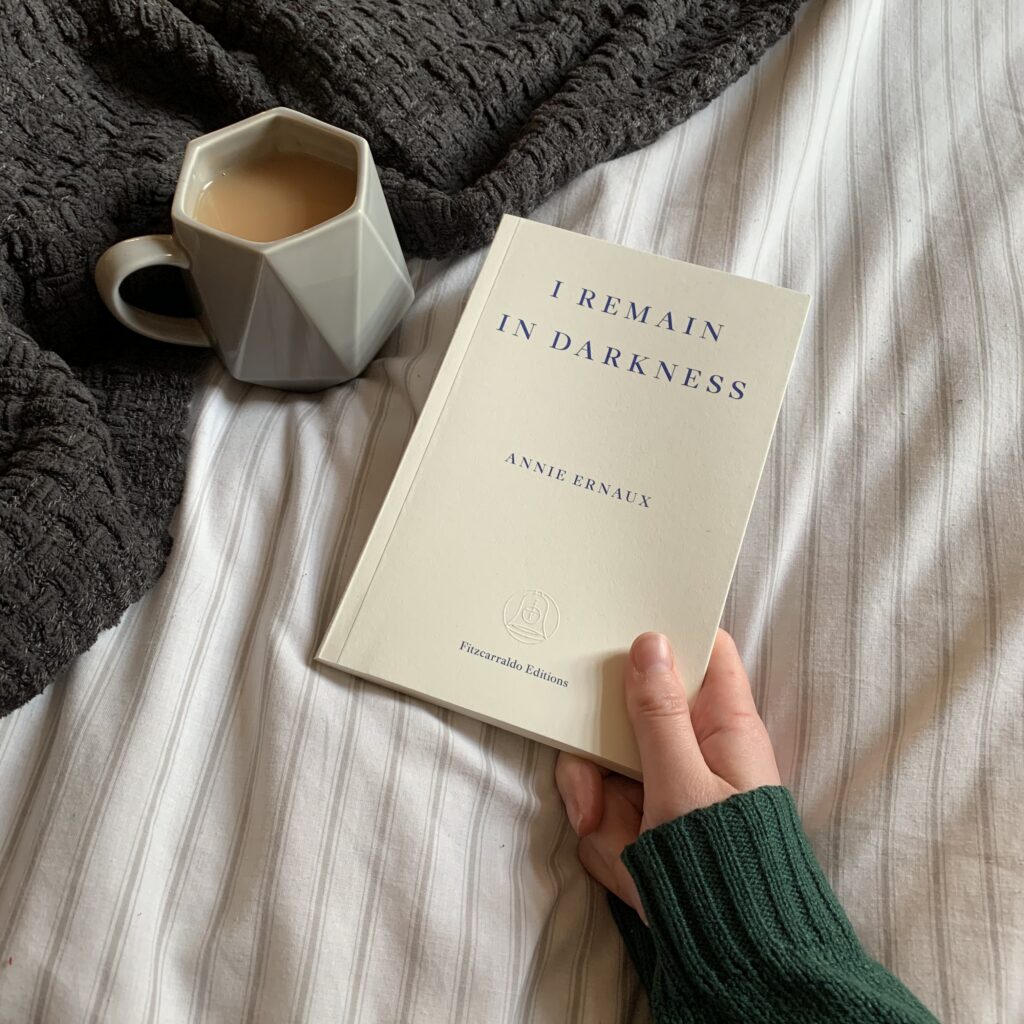
I decided to take a little break and sit down with Annie Ernaux’s I Remain in Darkness* after tea. Ernaux is one of my favourite women in translation with her intimate memoirs. At only 76 pages, I Remain in Darkness was perfect for a breather. Although if you know me, you’ll know that most of the books I read are rather emotionally taxing. I Remain in Darkness (translated by Tanya Leslie) is Ernaux’s raw and fragmented account of the few years leading up to her mother’s death. So not exactly light reading. But it was beautiful and honest as well as achingly sad (her mother suffered with Alzheimer’s).
Once I finished that, I took a deep breath and plunged back into the violence of Segu. I managed 60 pages before it was time for bed.
TUESDAY
I woke up full of determination to finish Segu today. Although it had only been four days, I felt like I’d lived a life with these characters. Once I finished my to-do list, I hunkered down to read the final stretch. I think Segu is one of those books I’d find it difficult to say I ‘enjoyed’, given the amount of rape and violence, but I’m certainly glad I read it. It’s more a book to appreciate than ‘enjoy’. In the afterword, Condé thanks colleagues for allowing her to make sure ‘this fiction does not take too many liberties with the facts.’
I definitely learned a lot about the ways Christianity and Islam were imposed in Africa, racism, and colonisation. A few lines from the book stuck with me:
‘He knew already that his mission would bring him back to Lagos. To Christianize and civilize Africa – that was his fate. To Christianize and civilize Africa. In other words, to pervert it?’
‘To civilize Africa by converting it to Christianity. But what did that mean? Didn’t every people have its own civilization, subtended by its belief in its own gods? What was converting Africa to Christianity but imposing another civilisation on it?’
There’s so much to consider in this book. It would have been a great one to study at university, with the right lecturer!
WEDNESDAY

After completing the 500-page tome of Segu, I was in the mood for another slim novel. I picked up Woman at Point Zero by Nawal El Saadawi, translated from Arabic by Sherif Hetata. (We love a husband and wife translator and author team around here!)
It’s incredible what El Saadawi manages to achieve in little over 100 pages. The main character Firdaus is based on a real woman the author met while researching for a psychiatry paper. The real Firdaus was also in prison for killing a man, sentenced to execution. When El Saadawi herself was imprisoned later in life for her feminist views, she kept thinking she had spotted Firdaus among the prison population. This is unsurprising, as anyone who hears this story will be unable to forget it.
The men Firdaus meets at various points in her life never fail to disappoint, neglect, or abuse her. She suffers as a daughter, a wife, a niece, an employee. When she turns to prostitution, she realises for the first time that she has agency over her body.
I thought the most powerful moment was when Firdaus, while employed in a ‘respectful’ job in an office, realises she earned more respect as a prostitute. The women she works with offer their bodies for a much lower price – to try and gain respect or maintain her job.
I highly recommend this one for Women in Translation Month, or just at any time.
It was still fairly early in the evening when I finished Woman at Point Zero, so I then made a start on The Door. I read Katalin Street by Magda Szabó in February, also translated by Len Rix, and really enjoyed it. But just from the first 25 pages, I could tell I would love this one even more.
THURSDAY
I know I’m not alone in saying that when I have unexpected free time, I completely waste it. My workload hasn’t returned to pre-Coronavirus levels yet, so some days are busier than others. I ended up with some free time on Thursday afternoon, and did I read? Did I hell.

However, after dawdling around the flat for a bit, I did sit down to read some more of The Door. I also started a new cross stitch which I’m excited about and listened to some of my audiobook. Currently I’m listening to If Cats Disappeared from the World by Genki Kawamura, translated by Eric Selland. Not a woman in translation, but a translation all the same! You can see in the picture above that I’ve started doing some fun, book-based cross stitches! No one has seen this one yet, so blog readers get a sneak peek! The one I’ve just started looks really cool already – hey, if you don’t toot your own horn, who will?!
Anyway, back to The Door! I’m so intrigued by the character of Emerence so far. I should have expected the slight quirkiness of this book, given that a dead girl narrates most of Katalin Street. But for some reason I didn’t, and it’s a delightful surprise every time something slightly off-kilter happens. Although I’m not sure if we’re supposed to sympathise with Emerence or not. I don’t, as she’s mean to a dog and that upsets me. I ended up reading 100 pages today.
FRIDAY
I had about 125 pages left of The Door, so I expected to finish that Friday night. However, I ended up in a weird reading mood in the evening and only read around 70 pages. I wasn’t finding it quite as engaging as on Thursday, but that may just be down to me. I still have an hour before bed at the time of posting this, but I’ll still probably end up finishing it on Saturday morning!
My library opened up for very limited collections, and I picked up a few random selections on Wednesday! As I was feeling a bit antsy, I cracked open Happiness, Like Water by Chinelo Okparanta and read the first story. I adored Under the Udala Trees a few years ago, so I’m looking forward to reading more of her work!
Penguin UK kindly sent me a free copy of Summer by Ali Smith (only my most anticipated title of the year!) a couple of weeks ago and it’s been eyeing me up from my shelf ever since. So I think that will be this weekend’s read.
Fin
If you made it to the bottom of this, then thank you! I hope you enjoyed another glimpse into my weekly reading life. I actually have a lot of fun writing these, it’s like a real-time bookish diary! That used to be what my Instagram was like, but then I ended up reading quicker than I could post. So now I mainly post reviews. This gives me more space to mull over the books I’m reading as I’m reading them.
If you missed last week’s round up, you can read that here.
I’m glad this blog is a place where you can write down your thoughts on books as you’re reading! I hadn’t really thought about that for myself, but I’m also really only reviewing these days. Except my problem is that I’m not reading enough / I’m not in the mood for reading books or writing reviews. ?
It’s quite interesting to look at the number of pages one reads per day because even if it’s a small amount, it’s still reading and it does add up. But I agree that if you’re just not in the mood, there’s no point forcing yourself to read. (Netflix, YouTube and podcasts are my best friends right now, haha… I’ll wait patiently for the reading bug to come back!)
Glad to see that WiT is going well for you so far! And I loved that sneak peek at your bookish cross-stitch too – reminds me of Elle’s bookish coffee art, actually!
Yeah! In the old days of bookstagram I was all about tags and reading updates, ha! I don’t miss doing the tags but I do miss just waking up and being like ‘hey I’m reading X today and it’s really good so far, bye!’ I have toyed with the idea of posting like before I go to bed with what I’ve read that day, but then I won’t have any time to post reviews, which is important for new releases! So I’m happy with this compromise 😀
I hope your reading mojo comes back soon, Steph! Thankfully there is a whole world of entertainment out there until it does 😉
And omg that is the highest of compliments! Thank you!
Ah, yes, the good old days of tags, hahaha. I know people still do them, but I think it’s been a while since I have!
Haha, yep, thank goodness I can be kept entertained by other things in the meantime. It is a bit annoying that my brain is like “woo, podcast time!!” and doesn’t let me read though. And then when I’m in an audiobook mood I just don’t listen to podcasts at all. ??
Maybe on IG if you post them there you could have a hashtag for them or something ?
Another wonderful week, Abbie!
I’ve just read my first Ernaux, A woman’s story. It’s about her mother. It was a very emotional read. I didn’t know there was another book about her mum. I’ll look for it.
Can I ask how you deal with reading about violence and especially rape and violence against women? I can’t deal with it. I have to read reviews beforehand so I don’t encounter it while reading a new book. I am unable to separate myself as a woman from the violence and would end up having nightmares and sometimes even panic attacks. There are lots of books that I haven’t read because they include such violence. I believe that it’s more commonplace nowadays in fiction. For example, in Latin American literature. I’m thinking about Fernanda Melchor or Mariana Enriquez. What do you think?
Thank you for writing these reading logs. I really love your insights.
Xx
Thank you Claire! I need to read A Woman’s Place still. I think I’m reading them all out of order, but I also don’t think it matters too much!
That’s a good question. A lot of the books I read feature very heavy themes like this, and it doesn’t get easier. You never get desensitised to it, and every time I read something like it, it affects me. But I also think it’s important for me that I do still read them and be aware that these are issues that persist everywhere. I know Fernanda said in her interview that she wanted to write about assault and misogyny in such a brutal way to try and get people to listen.
But at the same time, you need to know your own boundaries and what you’re capable of reading!